TL;DR: Armored vehicle selection depends on matching ballistic protection levels (B4-B7) to actual threat environments. B6 protection can cost $50,000-$250,000 (plus the vehicle) and stops rifle rounds—appropriate for most corporate executives in medium-risk regions.
Most security directors struggle to match protection levels to actual threats—resulting in either wasted resources on excessive armor or dangerous under-protection.
This guide analyzes ballistic standards, vehicle platforms, and total cost of ownership to help you select the right armored vehicle for your executive protection program. We’ve evaluated factory-armored options from premium manufacturers, aftermarket platforms from established armorers, and the operational considerations that determine real-world effectiveness.
What Makes an Armored Vehicle Suitable for Executive Protection?
Armored vehicles for executive protection must balance ballistic protection, operational mobility, and discretion. The foundation is understanding protection levels and how they map to real threats.
Ballistic Protection Levels Explained
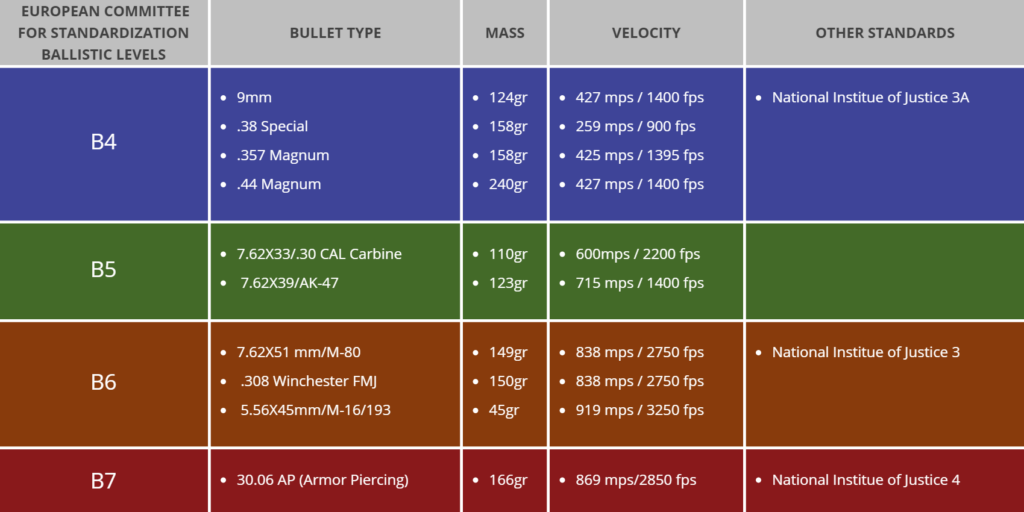
Protection levels follow standardized classifications, though terminology varies by region. The CEN 1063 ballistic protection standards establish resistance classes BR1 through BR7, with each level tested against specific ammunition types. U.S. NIJ standards use different test methodologies—NIJ Level III doesn’t equal CEN B6 due to different test distances, shot patterns, and ammunition specifications. Most manufacturers reference CEN classifications:
- B4 protection: Defeats handgun ammunition, including 9mm Parabellum and .44 Magnum. B4 armoring adds approximately 400 to 700 lbs to vehicle’s weight, depending on the size of the vehicle. Appropriate for low-risk stable regions where opportunistic handgun threats exist.
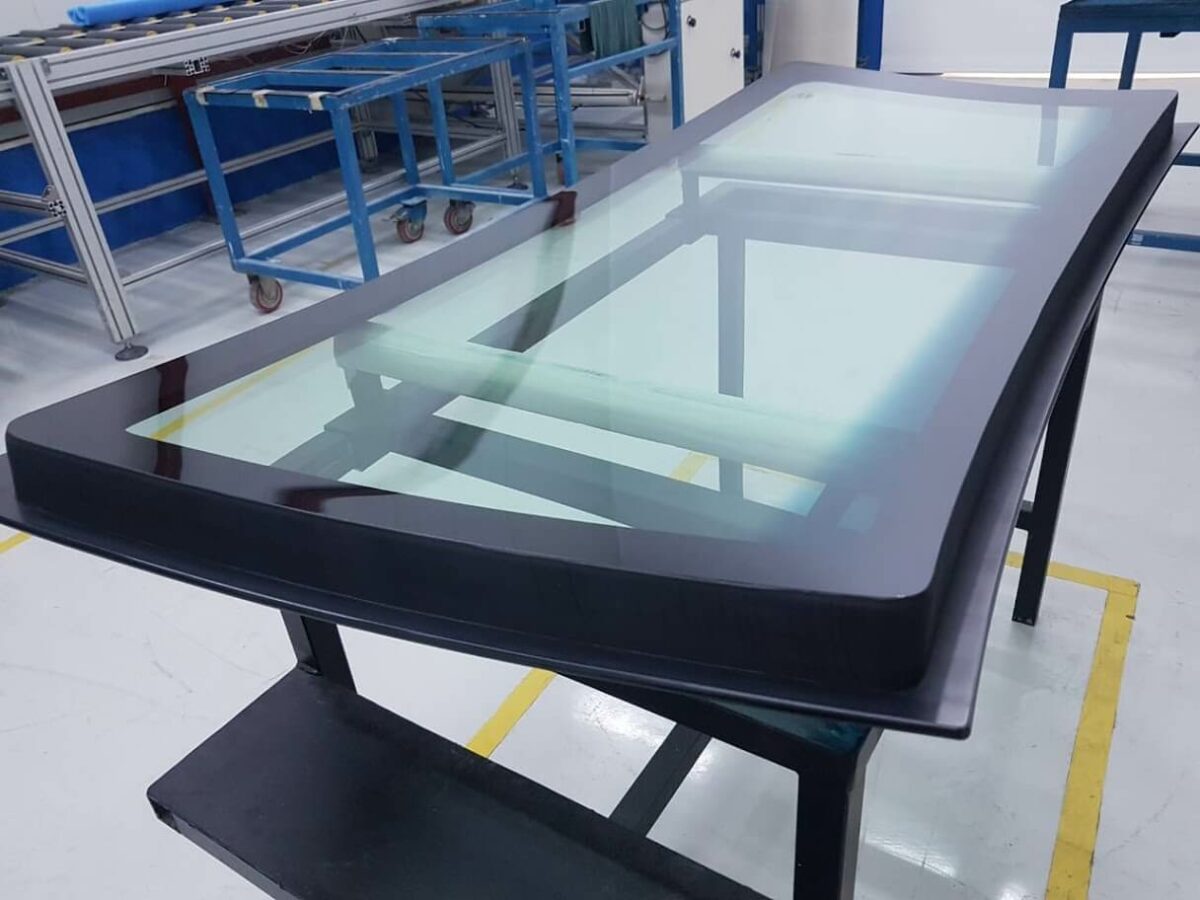
- B6 protection: Stops high-powered rifle rounds, including 7.62×51mm NATO (308 Winchester). Adds 1,200-1,800 lbs or more, depending on the size of the vehicle. Standard for corporate executives operating in medium-risk environments with organized crime presence.
- B7 protection: Withstands armor-piercing rifle ammunition. May be required for high-risk conflict zones or individuals facing sophisticated state-actor threats.
Weight Capacity vs Performance Trade-offs
Added armor weight fundamentally changes vehicle dynamics. Braking distances increase 5-20%. Acceleration decreases proportionally. Fuel consumption rises 10-35% depending on additional weight and vehicle specifications. Results may vary.
Body-on-frame SUVs (Suburban, Land Cruiser, Escalade) better support heavy armor due to chassis strength. The ladder-frame construction distributes armor weight across a rigid chassis rather than stressing the unibody structure. Unibody sedans can achieve B6/B7 but with greater performance compromises—though factory-armored sedans from Mercedes, BMW, and Audi engineer extensive reinforcement from the ground up.
Top 7 Armored Vehicles for Executive Protection (2026)
Here are the leading armored vehicle options for executive protection, ranked by protection capability, platform suitability, and total value proposition.
1. Armormax Armored Vehicles
Armormax specializes in manufacturing technologically advanced armored vehicles with world-class performance retention. Their approach focuses on maintaining the original vehicle’s handling characteristics while providing certified ballistic protection.
Protection Levels: B4 through B7 available across multiple platforms
Key Advantages:
- Advanced lightweight armor technology minimizes performance impact
- Maintains factory ride quality and handling dynamics
- Comprehensive warranty coverage on armor and integration
- Transparent ballistic testing with third-party certification
- Global service network for maintenance and support
Armormax armors SUVs, sedans, and specialty vehicles for corporate executives, government officials, and high-net-worth individuals. Their engineering process integrates armor during manufacturing rather than retrofitting, similar to OEM approaches but with greater platform flexibility.
Ideal Use Case: Organizations requiring certified protection across diverse vehicle platforms with minimal performance compromise. Particularly suitable for corporate fleets needing consistent protection standards across multiple regions.
Investment Range: $180,000-$850,000, depending on base vehicle and protection level
Learn more about Armormax’s armored vehicle solutions.
2. Mercedes-Benz S-Class
The S-Class represents the pinnacle of factory-armored luxury sedans. Armormax can take a Mercedes and add a variety of armoring solutions to integrate from the ground up, maintaining the S-Class’s signature ride quality while providing B6 or B7 protection.
Protection Level: B6/B7 Base Price Range: $200,000-$450,000 Ideal Use Case: High-profile executives requiring maximum discretion in urban environments
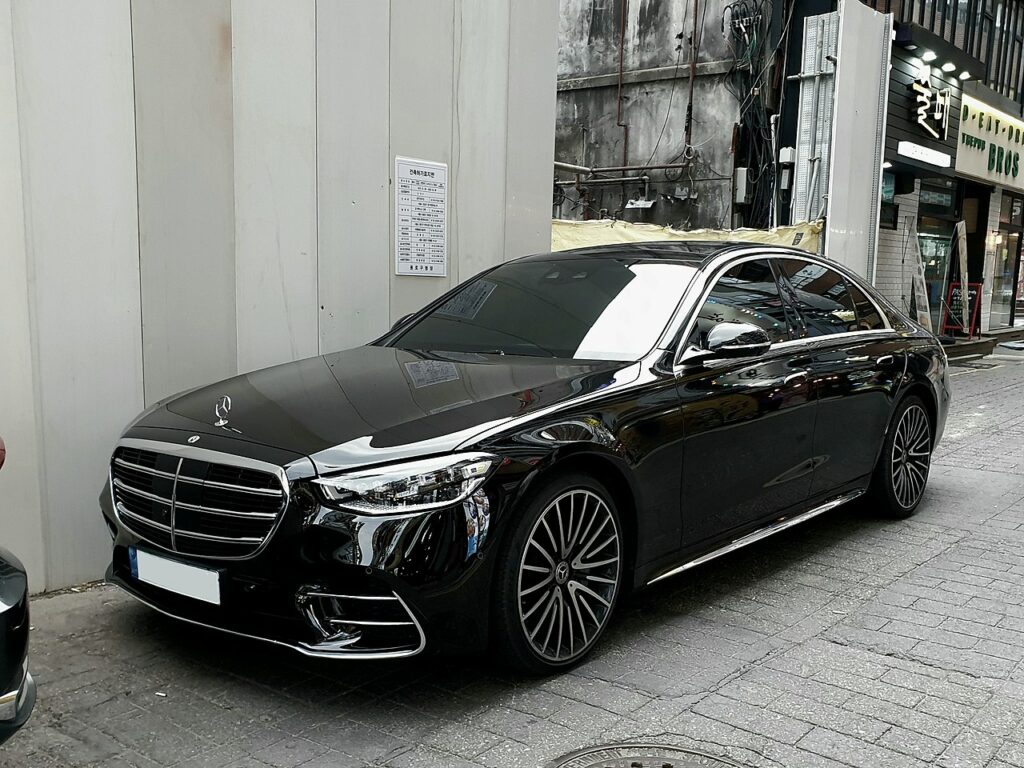
Key Features: Integrated intercom system, run-flat tires, emergency fresh air system, explosive-resistant underfloor protection (VR10 models)
3. BMW 7 Series Protection
BMW’s Protection B4 to B7 variants deliver factory-integrated armoring with dedicated driver training programs. The 7 Series platform balances protection with daily drivability.
Common Protection Levels: B6+ or B7 Weight: 1,300-1,900 lbs added Base Price Range: $300,000-$700,000 Ideal Use Case: Executives prioritizing handling dynamics and driver engagement
BMW includes specialized driver training covering increased braking distances, weight-related handling changes, and emergency maneuvers specific to armored vehicles.

4. Cadillac Escalade ESV
The Escalade ESV’s body-on-frame construction and extended wheelbase make it ideal for B6 armoring with security team capacity. Armormax says the Escalade is “the benchmark for luxury armored transportation” and “the gold standard of 2026.”
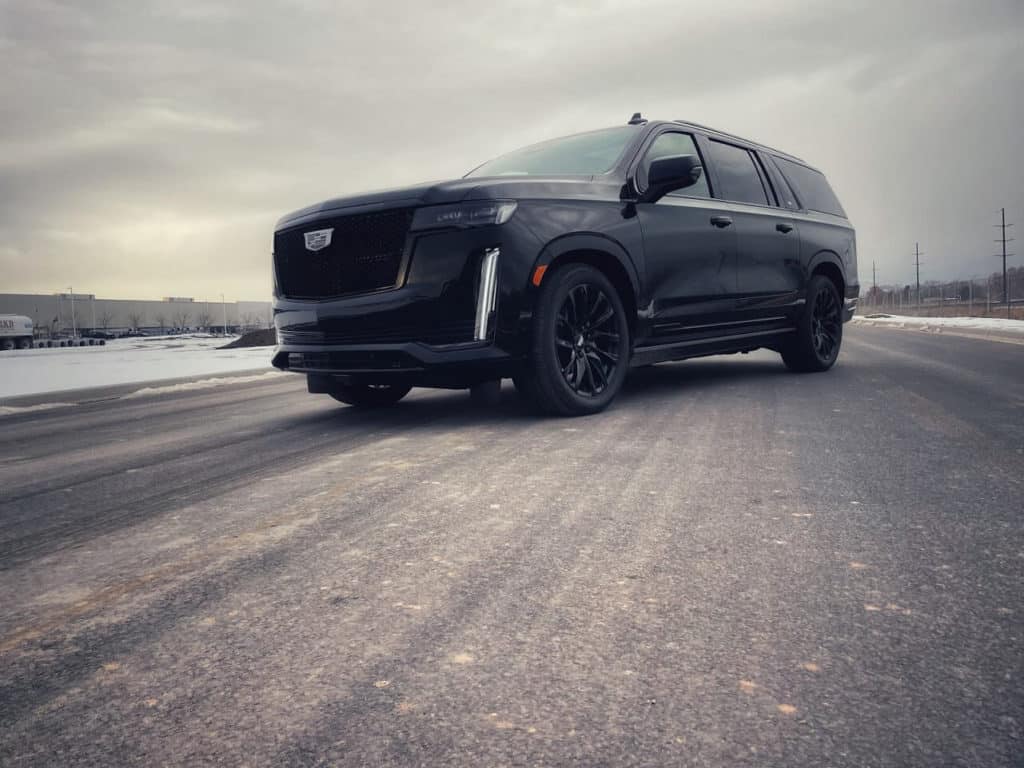
Protection Level: B6 standard Base Price Range: $180,000-$480,000 (including base vehicle) Ideal Use Case: Executive protection teams requiring 6-7 passenger capacity
Key Advantages: Spacious interior accommodates security personnel, high ground clearance for varied terrain, strong aftermarket armoring support from multiple manufacturers
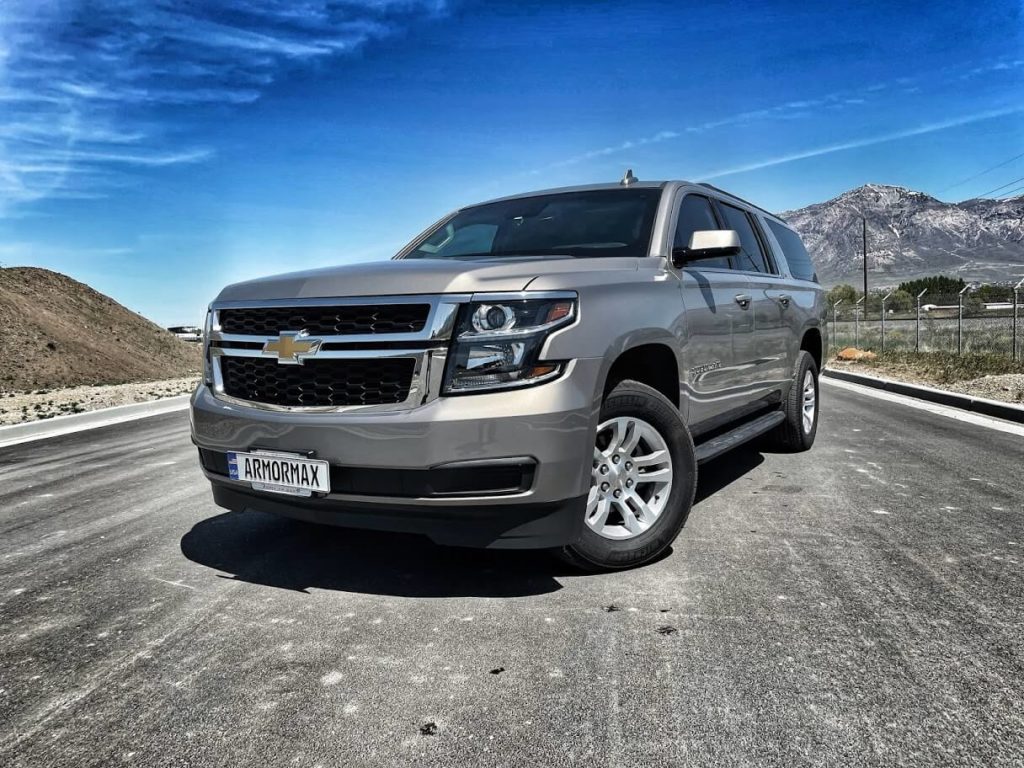
5. Chevrolet Suburban
The Suburban offers similar platform advantages to the Escalade at a lower entry price. Its ubiquity provides operational discretion—armored Suburbans blend with civilian traffic.
Protection Level: B6 standard Base Price Range: $140,000-$320,000 (including base vehicle) Ideal Use Case: Cost-conscious organizations needing proven protection with team capacity
Multiple armoring companies offer Suburban conversions with varying quality levels. Verify third-party ballistic certification and warranty terms.
6. Land Rover Range Rover
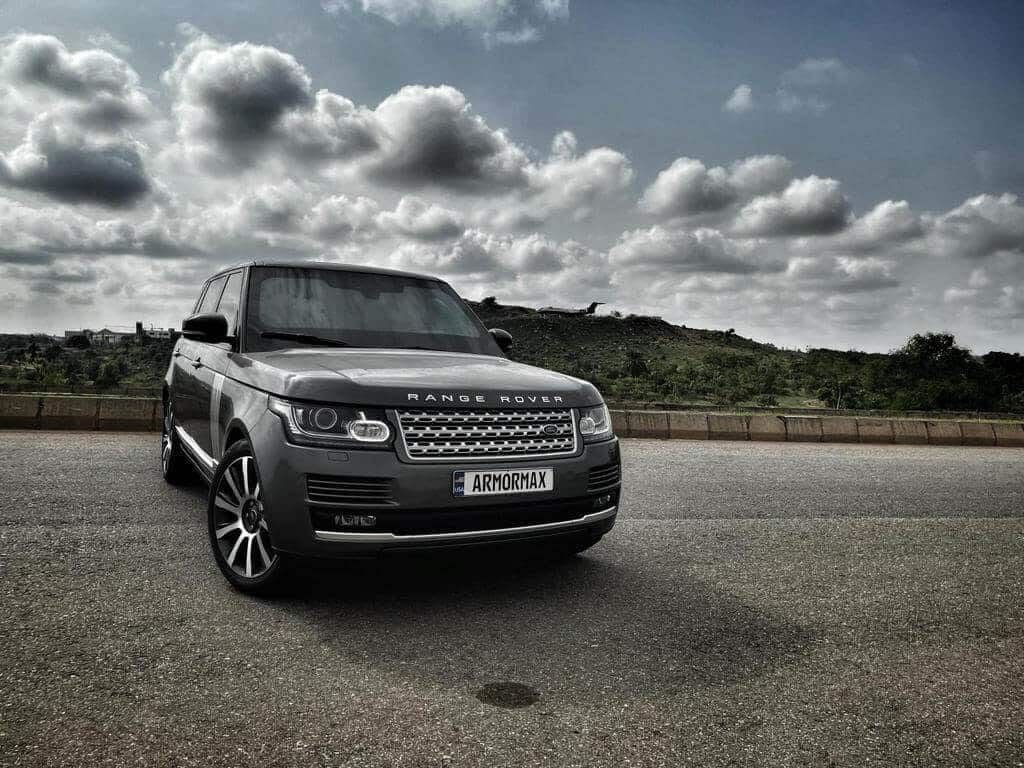
The Range Rover combines ultra concealed protection with genuine off-road capability—unique among factory-armored vehicles. Land Rover’s Special Vehicle Operations division engineers this model specifically for high-risk environments requiring terrain flexibility.
Protection Level: B7 (VR8 certification with underfloor blast protection) Base Price Range: $250,000-$450,000 Ideal Use Case: Executives operating in unstable regions with poor infrastructure
The Range Rover’s terrain response system adapts to 3.5-ton armored weight, maintaining off-road capability other armored vehicles sacrifice.
7. Toyota Land Cruiser 300 Series
The Land Cruiser’s global service network and legendary reliability make it the preferred platform for international deployments. Parts availability in developing regions is unmatched.
Protection Level: B6 standard (B7 available) Base Price Range: $140,000-$290,000 (including base vehicle) Ideal Use Case: International operations requiring service network access in remote regions
How Do Protection Levels Match Threat Profiles?
Selecting the wrong protection level wastes resources or creates false security. Match armor to actual threats based on geographic risk assessment and executive profile.
B4 Protection: Handgun Threats in Stable Regions
B4 armor defeats 9mm Parabellum, .357 Magnum, and .44 Magnum handgun rounds. This level addresses opportunistic attacks, carjackings, and low-sophistication threats.
Appropriate Environments:
- Western Europe (UK, France, Germany, Scandinavia)
- North America (United States, Canada)
- Australia and New Zealand
- Stable Asian markets (Japan, Singapore, South Korea)
Investment Range: $40,000-$180,000 plus base vehicle
Risk Scenario: CEO of a publicly traded company traveling domestically in the United States faces minimal organized threat but wants protection against random violence or opportunistic crime. B4 provides adequate protection without the performance penalties of heavier armor. Political stability and effective law enforcement reduce the likelihood of military-grade rifle attacks.
B6 Protection: Rifle Threats in Medium-Risk Environments
B6 armor stops 7.62×51mm NATO rifle rounds—the threshold where organized criminal groups and insurgent forces operate. This is the most common protection level for corporate executives in elevated-risk regions.
Appropriate Environments:
- Latin America (Mexico, Brazil, Colombia, Venezuela)
- Eastern Europe (Ukraine border regions, Balkans)
- Parts of Africa (Nigeria, Kenya, South Africa)
- Middle East (non-conflict zones)
- Southeast Asia (Philippines, parts of Indonesia)
Investment Range: $150,000-$650,000 including base vehicle and armoring
Risk Scenario: Mining company executive traveling regularly to operations in certain dangerous regions that face kidnapping risk from organized criminal groups with access to military-grade weapons. B6 protection addresses the rifle threat while maintaining operational mobility.
B7 Protection: Armor-Piercing Rounds in High-Risk Zones
B7 armor withstands armor-piercing rifle ammunition and explosive devices. This level is necessary only for the highest-threat environments or individuals facing state-actor threats.
Appropriate Environments:
- Active conflict zones (Afghanistan, Iraq, Syria, Yemen)
- High-intensity insurgency regions
- Individuals with specific credible threats from sophisticated actors
Risk Scenario: A government official or humanitarian organization leader operating in active conflict zone faces threats from groups with armor-piercing ammunition and IED capability. B7 with blast protection is the minimum viable protection level.
Annual Maintenance Premium
Armored vehicles incur 15-25% higher maintenance costs than standard equivalents. Accelerated brake wear, suspension stress, and specialized component requirements drive increases.
Standard Suburban annual maintenance: $2,000-$3,000 Armored Suburban annual maintenance: $2,500-$4,000 Annual premium: $500-$1,000
Brake pad replacement can occur more frequently. Suspension components wear faster under constant heavy load. Standard dealerships handle routine maintenance, while armor-related service requires certified facilities.
Tire Replacement Costs
Run-flat tire systems can cost $600-$1,500 per tire. Complete set replacement: $2,500-$6,000.
Standard vehicle tire replacement cycle: 50,000 miles Armored vehicle tire replacement cycle: 25,000 miles.
Fuel Consumption Impact Average Example
Added weight increases fuel consumption 20-35% depending on protection level and driving conditions.
Standard Suburban: 14-16 mpg combined B6 Armored Suburban: 10-12 mpg combined Fuel consumption increase: 25-30%
At 15,000 miles annually and $4.50/gallon:
- Standard: 1,071 gallons × $4.50 = $4,820 annually
- Armored: 1,364 gallons × $4.50 = $6,138 annually
- Annual fuel premium: $1,318
Insurance Premium Increases
Specialty insurance for armored vehicles costs significantly more than standard coverage. Premiums vary by protection level, deployment region, and coverage terms.
B4 protection in low-risk region: $2,000-$10,000 annually B6 protection in medium-risk region: $5,000-$15,000 annually B7 protection in high-risk region: $5,000-$15,000+ annually
Five-Year Total Cost of Ownership Example
Example Mercedes-Benz S-Class B6:
- Purchase price: $550,000
- Maintenance (5 years × $8,000): $40,000
- Tires (2 replacements × $5,000): $10,000
- Fuel premium (5 years × $2,000): $10,000
- Insurance premium (5 years × $15,000): $75,000
- Total 5-year cost: $685,000
Example Chevrolet Suburban B6:
- Purchase + armoring: $180,000
- Maintenance (5 years × $3,500): $17,500
- Tires (2 replacements × $4,000): $8,000
- Fuel premium (5 years × $1,300): $6,500
- Insurance premium (5 years × $12,000): $60,000
- Total 5-year cost: $472,000
The Mercedes costs over $200,000 more over five years—a 45% premium over purchase price. The Suburban’s total cost exceeds purchase price by 24%.
SUV vs Sedan: Which Body Type for Executive Protection?
Platform selection affects protection capacity, operational flexibility, and threat profile visibility.
SUV Advantages for Executive Protection
Team Capacity: Armored SUVs accommodate 6-7 passengers, including security personnel. The Escalade ESV and Suburban maintain third-row seating even with armor. Close protection teams require this capacity for advance security, driver, and executive.
Escape Terrain Capability: Body-on-frame SUVs handle unpaved roads, curbs, and obstacles that would disable sedans. In emergency evasion scenarios, this capability creates escape route options. Ground clearance and four-wheel-drive systems enable navigation across rough terrain if primary routes become blocked.
Weight Distribution: Body-on-frame chassis distributes armor weight more effectively than unibody construction. The Suburban’s ladder frame supports over 2,000 lbs of B6 armor with better handling retention than sedan platforms.
Presence and Deterrence: Large SUVs signal security presence, potentially deterring opportunistic attacks. This visibility is advantageous when deterrence outweighs discretion needs.
Sedan Advantages for Executive Protection
Lower Profile: Luxury sedans blend with corporate vehicle traffic. The S-Class, 7 Series, and A8 don’t signal VIP status as overtly as large SUVs. When discretion is paramount, sedans reduce attention.
Better Fuel Economy: Even with armor, sedans can achieve a better fuel economy than SUVs due to aerodynamics and lower base weight. Over 15,000 annual miles, this saves and estimated $800-$1,200 annually.
Urban Maneuverability: Sedans navigate tight parking structures, narrow streets, and urban congestion more easily. Weight restrictions in parking garages (often 6,000-7,000 lbs) sometimes exclude heavy armored SUVs but accommodate armored sedans.
Handling Dynamics: Factory-armored sedans from Mercedes, BMW, and Audi maintain superior handling compared to armored SUVs. For executives who drive themselves occasionally, this matters.
Choose SUV platforms when:
- Security team accompanies executive (3+ personnel)
- Operations include rural or unpaved areas
- Deterrence value outweighs discretion needs
- Budget supports under $200k for aftermarket armoring
Choose sedan platforms when:
- Executive travels solo or with single assistant
- Operations are primarily urban
- Discretion is paramount (high-profile individuals)
- Budget over $300k for factory-armored options and options
Critical Features Beyond Ballistic Protection
Run-Flat Tire Systems and Extended Mobility
Run-flat inserts or self-supporting tire systems enable continued mobility after tire damage. This capability is critical for escape from ambush or attack zones.
Two main approaches:
- Insert-based systems: Solid inserts inside standard tires support vehicle weight after deflation
- Self-supporting tires: Reinforced sidewalls carry load without air pressure
Both systems allow 50-100 miles of travel at reduced speed (up to 50 mph) after complete tire deflation. This provides sufficient range to reach secure locations.
Intercom Systems for Driver-Passenger Communication
Heavy ballistic glass and armor insulation reduce audibility between cabin compartments by 40-60 decibels. Normal conversation becomes impossible.
Integrated intercom systems are standard in quality armored vehicles. These enable:
- Driver-passenger communication during normal operations
- Security team coordination during incidents
- Privacy partition control in executive configurations
Emergency Escape Feature Examples
Ballistic impacts can jam armored doors, preventing normal exit. High-security armored vehicles incorporate emergency egress systems:
- Explosive bolt door releases: Small explosive charges blow door hinges if door jammed after attack
- Reinforced extraction tools: Specialized tools for emergency personnel to access occupants
- Emergency window breakers: Designed for ballistic glass (standard window breakers don’t work)
These features are required safety systems for B6+ vehicles operating in high-risk environments.
Blast Protection vs Ballistic-Only
Standard ballistic armor stops projectiles but doesn’t address explosive threats. Blast protection requires:
- Underfloor armor plates: Deflect explosive force away from the passenger compartment
- Reinforced floor pans: Prevent floor penetration from underneath detonations
- Energy-absorbing seats: Reduce spinal injury from blast overpressure
HVAC Systems for Sealed Environments
Armored vehicles feature sealed cabins to prevent gas attacks. Enhanced HVAC systems provide:
- Fresh air circulation: Prevents carbon monoxide accumulation during extended occupation
- Filtration systems: Standard enhanced filtration or NBC (Nuclear, Biological, Chemical) filtration for highest-threat environments
- Climate control: Maintains temperature in a sealed environment
Standard enhanced HVAC adds $3,000-$15,000 to armor cost. NBC filtration systems add $5,000-$20,000.
Weight-Appropriate Suspension and Braking
Added armor weight requires upgraded suspension and braking systems. Quality armoring includes:
- Heavy-duty suspension: Maintains ride height and handling with armor weight
- Upgraded brake systems: Larger rotors, performance pads, enhanced cooling
- Reinforced axles: Handle increased load without failure
These upgrades are non-negotiable for safety. Braking distances increase 30-45% even with upgraded systems—driver training must account for this.
Conclusion
Selecting the right armored vehicle for executive protection requires matching ballistic protection levels to actual threat environments, understanding the total cost of ownership beyond purchase price, and choosing platforms that balance protection with operational requirements.
B6 protection addresses rifle threats in medium-risk regions where most corporate executives operate—costing $150,000-$450,000 with five-year ownership costs reaching $250,000-$850,000. After market factory-armored sedans from Mercedes, BMW, and Audi offer integrated engineering and generous warranties but command premium pricing. Aftermarket SUV platforms provide team capacity and flexibility at lower entry costs.
The key is threat-matched protection: B4 for stable regions with handgun threats, B6 for medium-risk environments with organized crime, and B7 only for conflict zones with armor-piercing threats. Over-armoring wastes resources; under-armoring creates false security.
For organizations evaluating armored vehicle options, Armormax provides certified protection across diverse platforms with transparent testing and comprehensive support. Their approach balances protection requirements with operational mobility—critical for executive protection programs operating globally.
For questions or to armor your next vehicle with Armorma,x please call 1-801-393-1075.