TL;DR: Armored vehicle protection ratings are standardized classifications (B1–B7 CEN, NIJ Levels I–IV, VPAM 1–14) that specify which ballistic threats a vehicle can defeat. B6 protection—a common civilian level—stops 7.62×51mm NATO rifle rounds at 2,800 fps from AK-47s, while B4 handles handgun threats up to .44 Magnum or almost any high-powered hand-gun. Choosing the right level requires balancing threat assessment against cost, added weight and options, along with performance adjustments. Most civilian applications need B4 or B6; B7 armor-piercing protection is typically reserved for high-risk diplomatic or government use.
What Is an Armored Vehicle Protection Rating?
An armored vehicle protection rating is a standardized classification system that defines the level of ballistic resistance a vehicle provides against specific firearms and ammunition types. These ratings tell you exactly what threats your vehicle can withstand—from 9mm handgun rounds to armor-piercing rifle ammunition—based on rigorous testing protocols.
Based on our analysis of manufacturer specifications along with official standards documentation from CEN and NIJ, three primary rating systems dominate the global armored vehicle market.
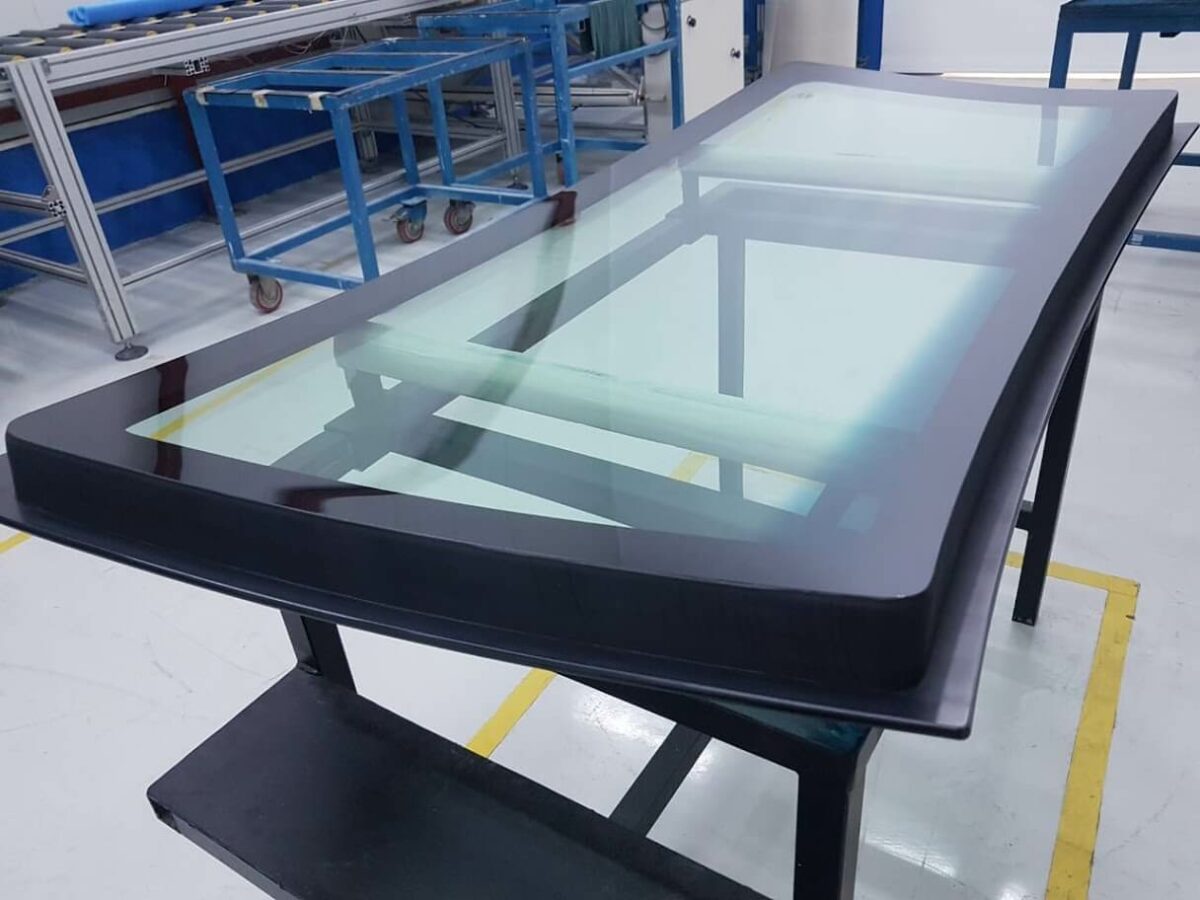
Tests are performed using specific guns to ensure that the glazed shielding must stop a specified number of bullets placed within 12 centimeters of each other. This standardized approach ensures buyers know precisely what protection they’re purchasing.
The European Standard classifies protection from B1 (lowest) to B7 (highest). The U.S. National Institute of Justice (NIJ) uses Levels I through IV for body armor, adapted for vehicle applications. Germany’s VPAM (Association of Test Centres for Attack-Resistant Materials and Structures) employs a 1–14 scale with stricter multi-hit testing requirements.
Why do standardized ratings matter? Without them, manufacturers could make unverifiable claims about protection capabilities. Insurance companies require certified ratings to underwrite policies. Government contracts mandate specific protection levels with independent testing documentation. For civilian buyers, ratings provide the only objective way to compare vehicles and ensure you’re getting protection that matches your actual threat environment.
How Do the Three Main Rating Systems Compare?
The CEN (European), NIJ (U.S.), and VPAM (German) standards use different testing methodologies and classification schemes, creating confusion for international buyers. Understanding these differences is critical for insurance acceptance and cross-border vehicle use.
CEN BR levels are a classification system defined by the European Committee for Standardization (CEN) under the standard EN 1063. The CEN system tests ballistic glass and armor panels separately, with seven protection classes (B1–B7) based on specific ammunition types and velocities.
NIJ standards, originally developed for body armor, classify protection from Level I (lowest) through Level IV (highest); which are Class I, IIA, II, IIIA, III, IV, V & VI.” North American government contracts typically require NIJ certification.
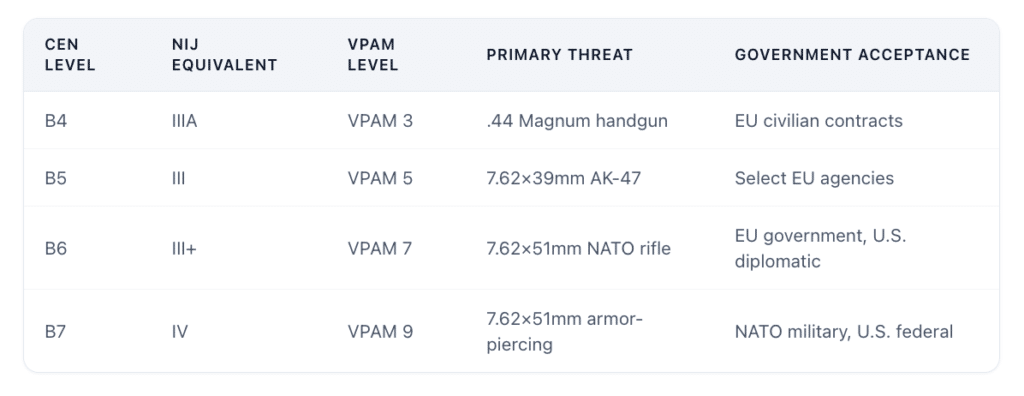
VPAM testing differs significantly in rigor. The most popular protection class for civil vehicles – B6 became VPAM 7 and another widespread protection class – B7 became VPAM 9.” VPAM requires multiple hits within 120mm spacing, while CEN allows greater shot dispersion.
Here’s how the systems align:
Geographic usage patterns matter for insurance and resale. European insurers typically mandate CEN 1063 compliance, while U.S. insurance companies prefer NIJ certification. VPAM certification carries premium value in Germany and Austria but may not satisfy North American underwriters without dual certification.
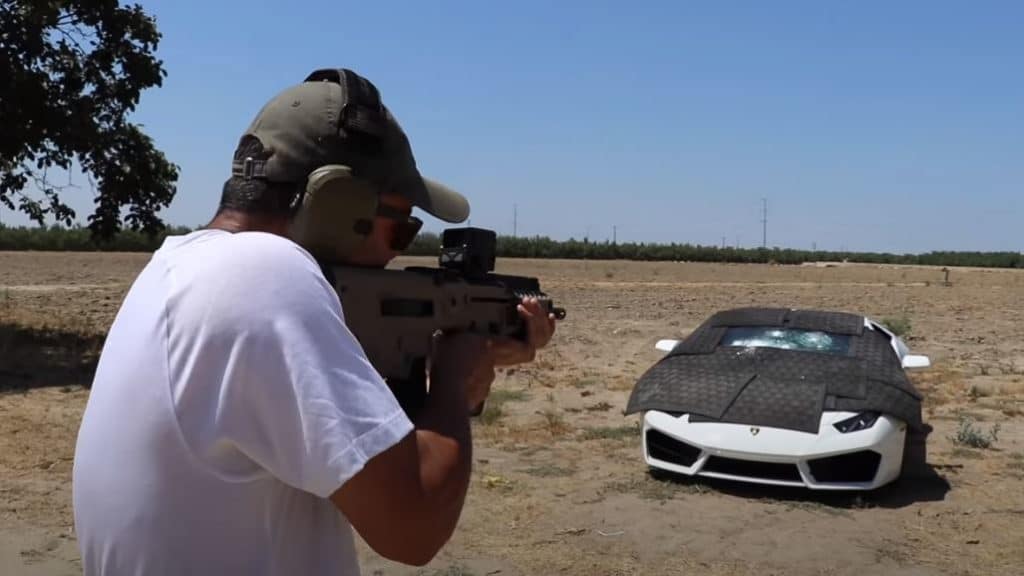
Testing methodology creates real performance differences. In testing, three bullets are usually fired at the center of a 500 x 500 mm pane of glass from a distance of 5 or 10 meters, depending on the resistance class, at an angle of 90° [from video archives of Mark Burton].
What Does Each Protection Level Defend Against?
Protection levels correspond to specific ammunition types and velocities. Understanding exactly what each rating stops—and what it doesn’t—is essential for matching armor to your actual threat environment.
B4 Protection: Handgun Defense
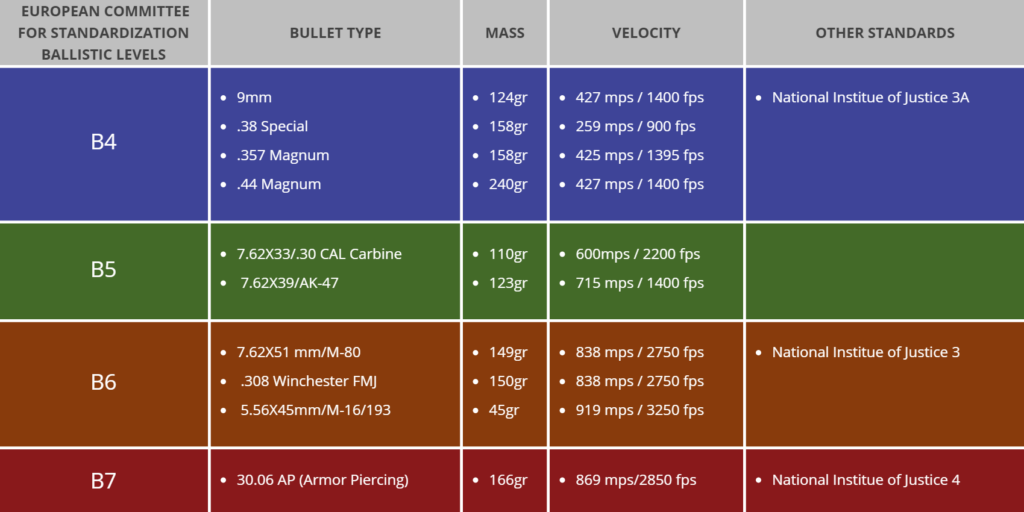
B4-rated vehicles are designed to protect against handguns and small arms fire. This includes common calibers such as .38 Special, .40 Caliber, .45 ACP, .357 Magnum, 9 mm, and .44 Magnum.
B4 armor uses aramid-based composite materials like Armormax. Glass thickness runs 21–22mm, adding approximately 180 kg (397 lbs) to vehicle weight.
Critical limitation: B4 provides limited protection against rifle calibers.
B5 Protection: Entry-Level Rifle Defense
B5 introduces hardened steel or composite materials to defeat 7.62×39mm ammunition. B5 armoring introduces hardened materials such as ballististic steel or composite material to defeat high velocity rifle threats like the 7.62×39 round commonly associated with AK style rifles.
B5 is capable of withstanding a .357 Magnum at 5 meters and B6 7.62 × 39 rounds from Kalashnikov rifle. This level bridges handgun and full rifle protection, offering a middle ground for moderate-risk scenarios.
B6 Protection: Full Rifle Defense
B6 represents the most common civilian protection level. This rating provides protection from AK-47s and other assault weapons and requires a ballistic steel thickness of at least 7.5 mm.
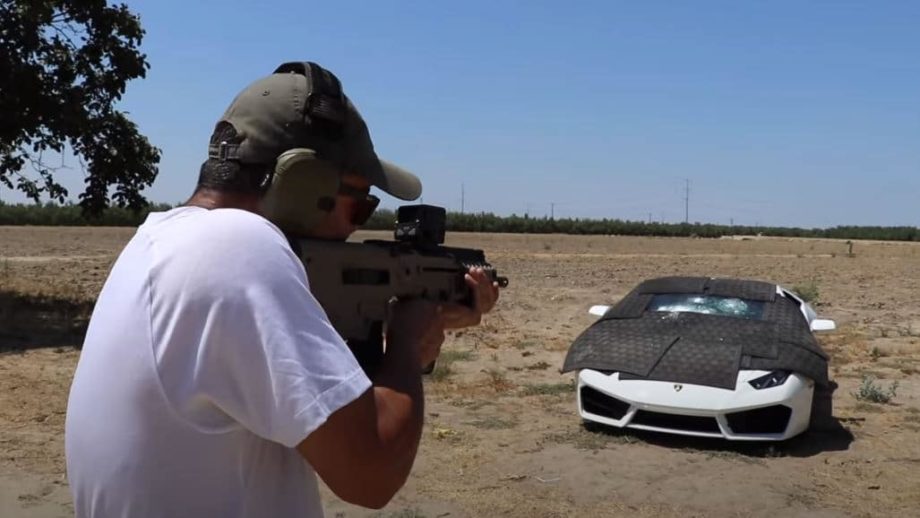
Level B6 Protection protects against: 7.62×39 M43 SC (AK47), 5.56×45 SS109 / M855 (M16), 7.62×51 M80 Ball (.308). This covers the most common military rifle calibers worldwide.
B6 glass measures “Typically 38 to 42 mm” thick. The 7.62×51mm NATO round travels at approximately 2,800 fps—B6 armor must defeat multiple impacts within a 120mm radius.
NIJ Level III provides equivalent protection.
B7 Protection: Armor-Piercing Defense
B7 represents the highest civilian protection level, designed for armor-piercing ammunition with hardened steel cores. The minimum required steel thickness for this level of protection is 12.5mm for B7.
At the B6/NIJ IV level and above the armor is designed to stop multiple 7.62 up to 30.06 AP (Armor Piercing) and Penetrator rounds and are also resistant to explosions.
Active conflict zones: B6 minimum (military weapons common)
High-value government targets: B7 (armor-piercing threat exists)
How Much Does Each Protection Level Cost?
Armoring costs vary dramatically by protection level, vehicle type, and material selection. Understanding the full cost breakdown—including hidden expenses like performance upgrades and maintenance—is essential for budgeting.
For specific pricing on each package and armoring level please call 1-801-393-1075.
Hidden Ownership Costs
Beyond initial armoring, budget for ongoing recommendations to keep your vehicle healthy long-term
Suspension service (every 15K miles vs 30K unarmored)
Specialized insurance premiums
Premium Fuel costs
Which Protection Rating Do You Actually Need?
Selecting the appropriate armor level requires structured threat assessment—not emotional decision-making or “maximum protection” thinking. Over-armoring wastes capital and reduces the vehicle’s escape capability, potentially compromising safety.
Threat Assessment Framework
Start by evaluating four risk factors:
Geographic threat environment: Research local crime statistics, kidnapping rates, and weapon availability. Regions with organized crime typically see rifle-caliber weapons; street crime involves handguns. Armoring selection starts with understanding the client, not selling a rating or a certain type of protection. All the armoring is designed to fit the vehicle and client situation, not the other way around.
Professional profile and visibility: High-net-worth individuals, corporate executives, and government officials face elevated kidnapping risk. Public figures attract more sophisticated threats than private business owners.
Travel patterns and route predictability: Predictable daily routes (home to office) increase ambush risk. Varied, unpredictable travel reduces threat probability but may expose you to unfamiliar areas.
Escape vs. protection strategy: If your security doctrine prioritizes rapid escape over static protection, excessive armor weight becomes a liability. B7 protection reduces 0–60 mph acceleration by 4–6 seconds compared to unarmored vehicles—potentially the difference between escape and capture.
Common Use Cases by Protection Level
B4 scenarios:
Corporate executives in low-to-moderate crime cities
High-net-worth individuals with discreet security needs
Most implement a CEN B6 level armoring package for the vast majority of its civilian vehicles, a B4 armoring package for its cash-in-transit vehicles.
B4 is a common choice for civilian armored vehicles that have concerns with carjackings and kidnapping attempts and want to use their vehicle on a daily basis.
B6 scenarios:
Diplomatic personnel in high-risk postings
VIP transport in conflict-adjacent regions
Corporate executives in kidnapping hotspots (Latin America, parts of Africa)
Government officials require proven rifle protection
According to market data, B6 represents 60–70% of civilian sales.
B7 scenarios:
Active conflict zones with armor-piercing ammunition
High-value government targets (heads of state, military leaders)
Diplomatic missions in war zones
Specialized military/security applications
How Are Armored Vehicles Tested and Certified?
Independent testing and certification separate legitimate armor from unverified claims. Understanding the certification process helps you verify protection levels and avoid fraudulent products.
Testing Facility Requirements
Accredited testing labs must meet ISO 17025 standards for ballistic testing competence. In testing, three bullets are fired at the center of a 500 x 500 mm pane of glass from a distance of 5 or 10 meters, depending on the resistance class, at an angle of 90°.
In order to comply, the glass must be shatterproof and not crack or flake after impact. Testing includes both penetration resistance and structural integrity verification.
The official testing and certification of our entire portfolio of bullet-proof vehicles is carried out by the independent national proof house. Independent certification—not manufacturer self-testing—is required for most insurance claims to accept.
Testing Protocol Details
CEN 1063 testing requires:
Minimum 3 shots per test panel
120mm maximum spacing between impacts
Witness panel behind armor to verify non-penetration
Specific ammunition types and velocities per protection class
Temperature conditioning (testing at -20°C and +55°C)
VPAM testing adds stricter requirements.
Certification Documentation Buyers Should Request
Before purchasing, demand these documents:
Certification letter from accredited lab: Must include testing date, protection level achieved, and lab accreditation number. Verify lab accreditation through ISO or national standards bodies.
Complete testing report: Should include shot logs with impact locations, velocities measured, witness panel examination results, and photographic documentation of test panels.
Material specifications: Ballistic steel thickness, glass composition and thickness, composite material types. Cross-reference against standard requirements (e.g., B6 requires minimum 7.5mm steel).
Quality management certification: ISO 9001, ISO 14001, or equivalent. Armormax may provide vehicles and contract vehicles with ballistic materials that adhere to certified global standards such as ISO 9001, ISO 14001, and ISO 45001, in some examples
Vehicle-specific testing documentation: Generic material testing isn’t sufficient. The complete vehicle assembly must be tested, as installation quality affects protection.
Red Flags in Unverified Armor Claims
Watch for these warning signs:
“Ballistic-rated” without specifying CEN/NIJ/VPAM level: Meaningless marketing term
Manufacturer self-certification only: No independent verification
Missing testing lab accreditation: Anyone can claim to be a “testing facility”
Vague protection claims: “Stops rifle rounds” without specifying caliber, velocity, or number of hits
No material specifications: Legitimate armor includes precise thickness and material composition
Refusal to provide testing documentation: If they won’t show certification, it probably doesn’t exist
Quality Assurance Beyond Initial Testing
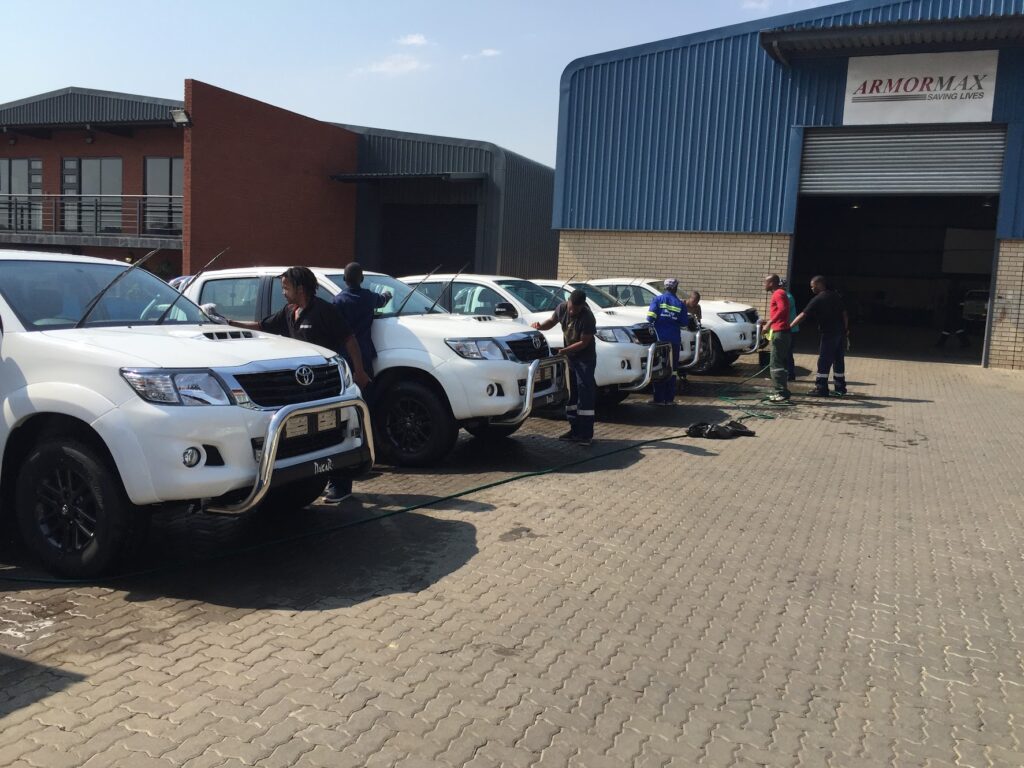
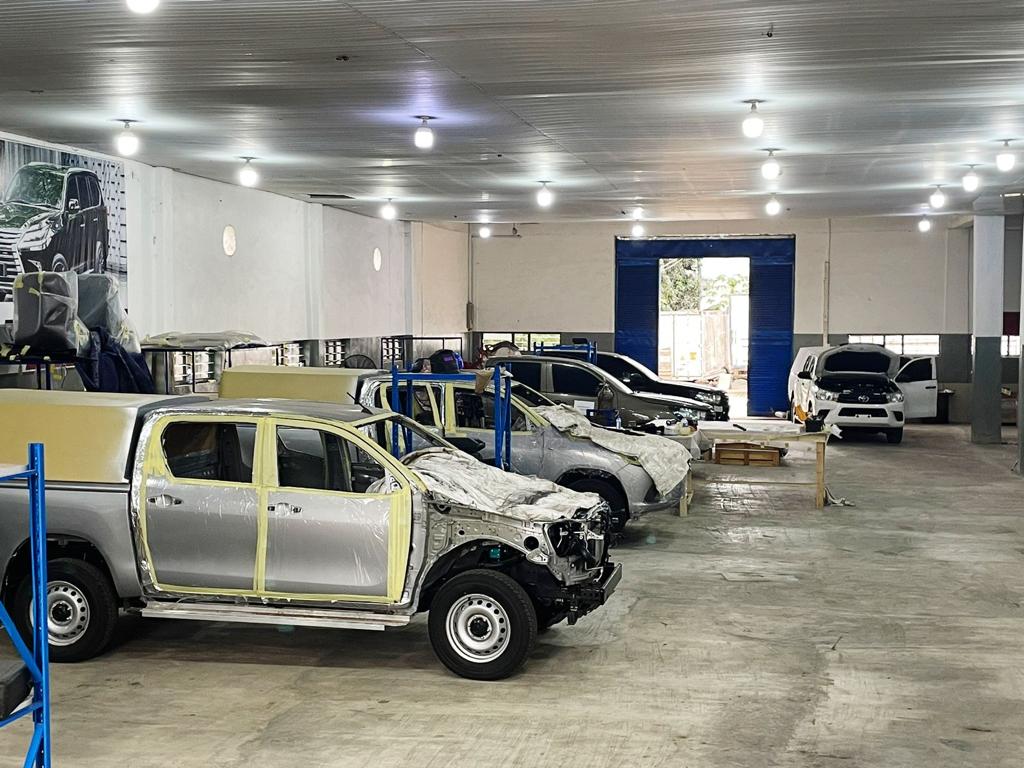
Every Armormax armored vehicle undergoes a series of performance and quality assurance tests before delivery. This includes a road test for handling and comfort, a water test to check for leaks at all entry points, and a full tech test to verify the functionality of all electrical and security systems.
Post-installation testing should include:
Water leak testing (armor installation creates new seal points)
Electrical system verification (armor adds weight to doors, affecting sensors)
Suspension and brake performance testing
Weight distribution analysis
Final visual inspection for installation quality
For buyers evaluating armored vehicles, companies like Armormax provide transparent certification documentation and can guide you through verification of protection claims. Always insist on seeing independent testing reports before finalizing any armored vehicle purchase.
Conclusion
Armored vehicle protection ratings provide standardized, verifiable classifications that match specific ballistic threats to protection levels. B4 armor handles handgun threats for $45,000–$75,000, B6 defeats assault rifles for $120,000–$180,000, and B7 stops armor-piercing rounds for $250,000+. The right protection level depends on structured threat assessment—not emotional decision-making or “maximum protection” thinking.
Most civilian applications require B4 or B6 protection. Over-armoring to B7 when threat assessment doesn’t justify it wastes $100,000+ and reduces escape capability through weight penalties that slow acceleration by 4–6 seconds and increase braking distance by 20–30%. Always verify independent certification from accredited testing labs and request complete documentation including shot logs, material specifications, and witness panel examination results.
For guidance on selecting the appropriate protection level for your specific threat environment, companies like Armormax offer consultation services that help match armor ratings to real-world security needs. Their expertise in ballistic protection can help you avoid both under-protection and costly over-armoring while ensuring you receive legitimate, independently certified armor that meets your insurance and operational requirements.
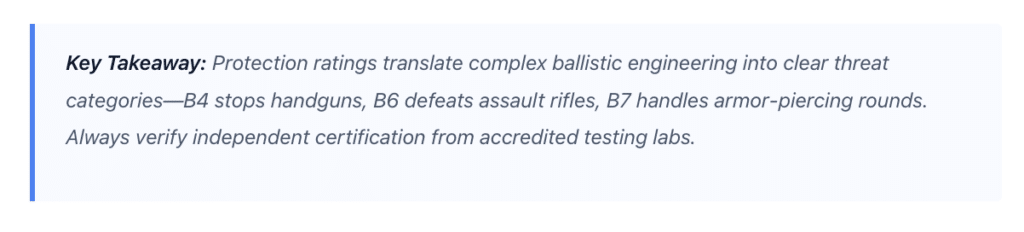
B6 defeats standard 7.62×51mm NATO rifle rounds (AK-47, M16) at 2,800 fps while B7 stops armor-piercing 7.62×51mm rounds with hardened steel cores at the same velocity.
B6 protects against high-powered rifles while B7 protects against armor-piercing rounds. The weight difference is substantial: B6 adds 550–600 kg versus 815–900 kg for B7 per Armored-cars data. B7 protection is only necessary when armor-piercing ammunition threats are documented in the operating environment.
Upgrading from B4 to B6 after installation is technically possible but economically impractical—you'll pay 60–80% of new armoring cost plus removal expenses.
Existing armor must be removed before installing higher-level protection. Ballistic glass cannot be upgraded in place—windows require complete replacement. Door panels, floor armor, and roof protection all need removal and replacement. Labor costs for removal add $15,000–$25,000 to new armoring expenses. Most manufacturers recommend selecting the correct protection level initially rather than planning upgrades.
B6 represents 60–70% of civilian armored vehicle sales globally, followed by B4 at 20–25%.
B4 remains the most common choice for civilian armored vehicles used daily while CEN B6 level armoring package for the vast majority of its civilian vehicles. B6 provides rifle protection without the extreme weight and cost penalties of B7.
Certification doesn't expire, but armor components degrade over time—ballistic glass can lasts 10+ years (but the warranty is usually for 24 to 36 months), aramid panels can last the life the vehicle, and steel armor 15+ years before replacement is recommended.
Certification documents remain valid for the tested configuration, but physical armor degrades through UV exposure, temperature cycling, and material fatigue. Annual integrity inspections verify armor condition. Insurance companies may require re-certification if armor components are replaced or if the vehicle undergoes major modifications.
No—higher ratings protect against more powerful threats but reduce vehicle performance, potentially compromising escape capability in ambush scenarios where speed matters more than armor thickness.
B7 protection adds 1,800+ lbs, reducing 0–60 mph acceleration by 4–6 seconds and increasing braking distance by 20–30%. Fuel economy drops 25–35%, reducing operational range. For most civilian and executive clients, B4 or B5 protection provides meaningful security without sacrificing drivability or discretion. Match armor to actual threat environment—over-armoring wastes capital and may reduce overall security effectiveness.