For questions or to speak with an armoring specialist at Armormax, please call 1-801-393-1075 or email [email protected] / www.armormax.com/contact
TL;DR: Bulletproof vehicles undergo rigorous multi-phase testing including ballistic resistance tests (firing 7.62×51mm NATO rounds at armor panels for example), blast testing with TNT charges up to 15kg at 2-meter standoff distances, and post-armor performance validation. Testing occurs in two distinct phases: material testing before installation and full vehicle testing after armoring. Independent third-party certification following standards like NIJ, CEN 1063, and VPAM ensures protection levels meet documented specifications. The complete testing process typically takes 6-8 weeks from vehicle arrival to final certification.
You’re reading this because you need to understand whether an armored vehicle will actually protect occupants when it matters most. The difference between certified protection and marketing claims can be measured in millimeters of steel and documented test results.
Based on our analysis of testing protocols, Intertek’s transparent armor testing services, and blast certification data, this guide explains the complete testing sequence that determines whether a bulletproof vehicle meets its claimed protection level.
What Testing Do Bulletproof Vehicles Undergo?
Bulletproof vehicles undergo a structured four-stage testing process: material qualification testing, component assembly verification, full vehicle ballistic testing, and post-armor performance validation. Bulletproof cars are typically tested in two phases: first testing materials for quality before the armoring process, then testing the complete armored vehicle with “zero tolerance for errors” based on the level that is being certified and the needed requirements.
The testing process begins several weeks before a vehicle is eligible to receive its final certification. The exact testing schedule and timeline may vary depending on the independent authority responsible for conducting the certification:
Material Testing (2-3 weeks): Ballistic panels, transparent armor, and door components undergo individual testing before vehicle assembly. Each material must meet protection level specifications for projectile resistance and spall containment. This prevents costly failures during full vehicle testing.
Component Assembly (1-2 weeks): Armor integration into the vehicle structure, including door reinforcement, floor protection, and transparent armor installation. Individual armor panels undergo ballistic testing at certified ranges. Door assemblies, window systems, and floor plates receive separate validation. Each component must pass its protection level requirements independently.
Ballistic Testing (3-5 days): Full vehicle testing represents the critical validation phase. that “testing is done at different angles, speeds, and distances to simulate different attack scenarios.” This multi-angle approach ensures protection from realistic threat vectors, not just perpendicular impacts.
Performance Validation (1-2 weeks): Post-armor testing validates that added weight hasn’t compromised vehicle safety. Braking distance, suspension load capacity, and handling characteristics undergo measurement. According to Armormax, “the full armoring process of a vehicle can typically be completed in less than a month,” with testing integrated throughout this timeline.
The timeline from vehicle arrival to certification spans 6-8 weeks for standard protection levels. The Drive reports that “it takes six to eight weeks to armor typical vehicles like a Mercedes-Benz, Range Rover, Escalade, Tahoe, or Suburban.” Higher protection levels requiring thicker armor and more extensive testing can extend this to 10-12 weeks.
Key Takeaway: Bulletproof vehicle testing follows a four-stage process from material qualification through full vehicle certification, typically requiring 6-8 weeks with testing at multiple angles and distances to validate real-world protection.
How Is Ballistic Protection Tested?
Ballistic protection testing fires standardized ammunition at armor panels from specified distances, measuring penetration depth and spall containment. The test uses calibrated firearms, chronographs to verify projectile velocity, and backing materials to capture any penetration or fragmentation.
Testing protocols vary by standard but share core methodology. Armormax explains that “this involves shots where bullets are fired at the material from a distance of the analyst’s choice,” though certified testing requires specific standoff distances—typically 5 meters for rifle ammunition and 10 meters for handgun rounds.
Three major standards govern ballistic testing worldwide:
NIJ (National Institute of Justice) – U.S. standard defining protection levels from IIA (9mm) through IV (.30-06 armor-piercing). Level III requires stopping 7.62×51mm NATO rounds.
CEN 1063 – European standard with classifications from BR1 (handgun) through BR7 (armor-piercing rifle). BR6 protects against 7.62×51mm NATO at 830 m/s (2,723 fps).
VPAM – German standard with vehicle-specific ratings from VR1 through VR10.
| Standard | Level | Threat | Velocity | Shot Pattern | Min. Steel Thickness |
|---|---|---|---|---|---|
| NIJ | III | 7.62×51mm NATO | 2,780 fps | 6 shots, 2″ spacing | Not specified |
| CEN 1063 | BR6 | 7.62×51mm NATO | 830 m/s (2,723 fps) | 3 shots, 120mm spacing | 7.5mm (B4) to 18mm (B7) |
| VPAM | VR7 | 7.62×51mm AP | 820 m/s (2,690 fps) | 5 shots, 50-120mm spacing |
Shot pattern requirements determine test rigor. Standards typically require 3-7 rounds per test panel with specific spacing. VPAM standards mandate shots spaced 50-120mm apart to test multi-hit capability—simulating an attacker firing multiple rounds at the same area. This tighter spacing is more rigorous than NIJ’s 2-inch (51mm) minimum.
Pass/fail criteria focus on two measurements: complete penetration and spall containment. Armormax offers that armor must protect “from several dangers such as ballistic dangers and dangers from explosive components.” No projectile or fragment can fully penetrate to the protected side. Backing material deformation is measured but acceptable limits vary by standard.
What Weapons Are Used in Testing?
Testing ammunition follows strict specifications for consistency. Common test rounds by protection level include:
9mm FMJ – 124-grain full metal jacket at 1,400 fps for handgun protection levels
.44 Magnum – 240-grain at 1,400 fps for intermediate protection
7.62×51mm NATO – 147-grain full metal jacket at 2,780 fps for rifle protection
.30-06 M2 AP – 166-grain armor-piercing rounds for highest protection levels
Chronographs positioned near the target verify each shot meets velocity requirements. Shots falling outside the specified velocity range (typically ±30 fps) are repeated. This ensures armor faces the exact threat level it claims to stop.
Key Takeaway: Ballistic testing fires standardized ammunition (like 7.62×51mm NATO 147-grain at 2,780 fps) at armor panels from 5-10 meters, requiring 3-7 shots per panel with 50-120mm spacing and no complete penetration or spall reaching the protected side to pass certification.
How Are Bulletproof Windows Tested?
Bulletproof windows undergo specialized testing beyond standard armor panels due to optical clarity requirements and multi-layer construction. Transparent armor testing evaluates ballistic resistance, spall containment, optical distortion, and environmental durability.
The testing process begins with ballistic impact tests using the same ammunition as opaque armor. However, window testing adds complexity. Multi-hit testing places 3-7 rounds in tight patterns (100-120mm spacing) to verify the glass system maintains integrity after multiple impacts. Single-hit testing only validates one shot per panel.
Intertek’s transparent armor testing follows standards including “ANSI Z26.1: Safety glazing materials for motor vehicles” and “MIL-STD-11352H: Military standard for glass, laminated, flat, and curved.” These standards specify both ballistic performance and optical requirements.
Spall containment becomes critical for transparent armor. Glass fragments on the protected side can cause serious injuries even if the projectile doesn’t penetrate. Test protocols measure fragment size, velocity, and distribution. Acceptable spall limits vary by standard but typically require all fragments remain attached to the laminate or fall within a defined area.

Temperature cycling tests subject windows to thermal extremes. Laminated glass uses polymer interlayers that can delaminate under temperature stress. Testing alternates between -40°C and +63°C to verify adhesive integrity. This simulates years of seasonal temperature changes.
Optical clarity standards ensure driver visibility after impact. Windows must maintain minimum light transmission (typically 70%) in undamaged areas. Distortion measurements verify the glass doesn’t create visual artifacts that impair driving. Test shots are placed outside the driver’s primary vision zone to maintain post-attack visibility.
Environmental testing includes:
UV exposure – Accelerated weathering simulates years of sunlight to test for yellowing in polycarbonate-based transparent armor
Humidity cycling – 95% relative humidity at elevated temperatures tests adhesive degradation and delamination resistance
Salt spray – Corrosion testing for edge seals and mounting hardware per automotive standards
As a general rule of thumb, B4 to B5 ballistic protection levels are typically recommended for private civilian vehicles because they offer an ideal balance between security, vehicle performance, and luxury features. This balance reflects the inherent trade-off between protection level and armor thickness. Higher ballistic ratings require thicker glass and additional armor materials, which can reduce visibility, increase vehicle weight, and affect driving performance.
Window testing also validates the complete installation system. Mounting hardware, seals, and retention systems undergo testing to ensure windows remain secure under ballistic impact. A window that stops bullets but separates from its frame provides no protection.
Key Takeaway: Bulletproof window testing requires multi-hit ballistic testing (3-7 rounds at 100-120mm spacing), spall containment validation, optical clarity verification (70% minimum light transmission), and environmental durability testing including temperature cycling from -40°C to +63°C and 95% relative humidity exposure.
What Is Vehicle Blast Testing?
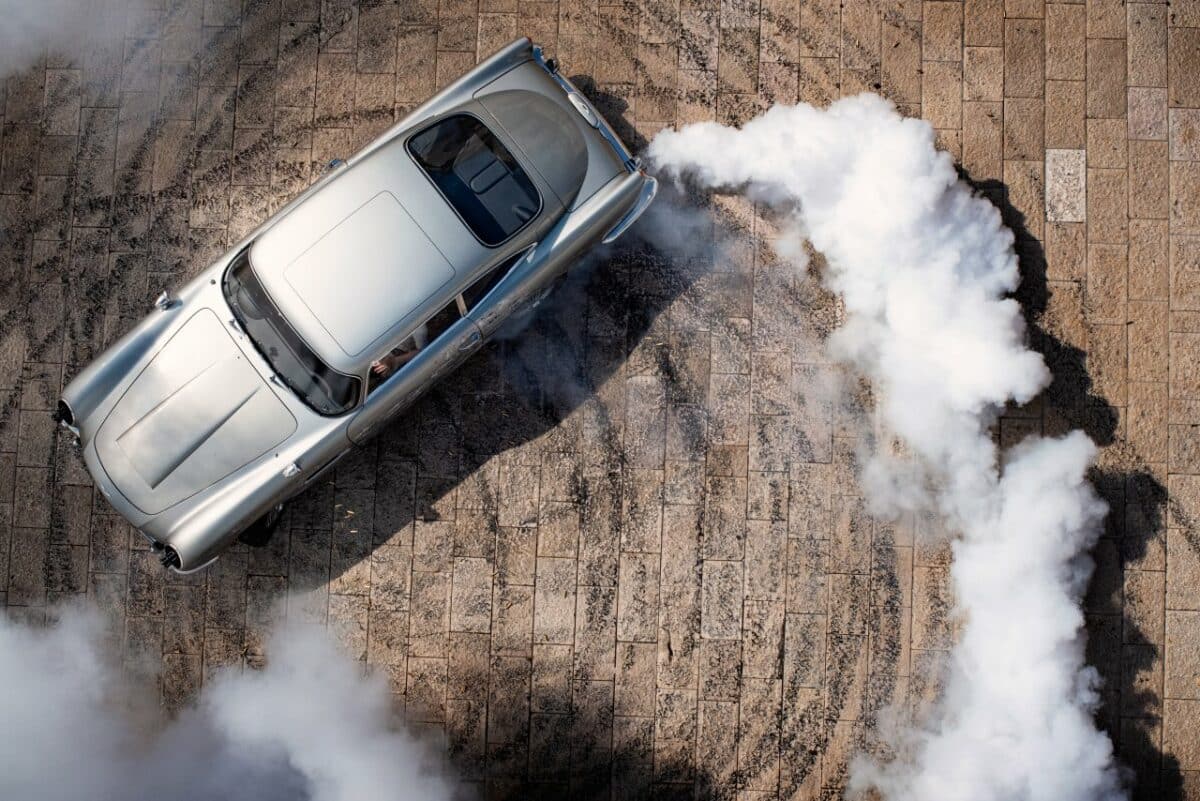
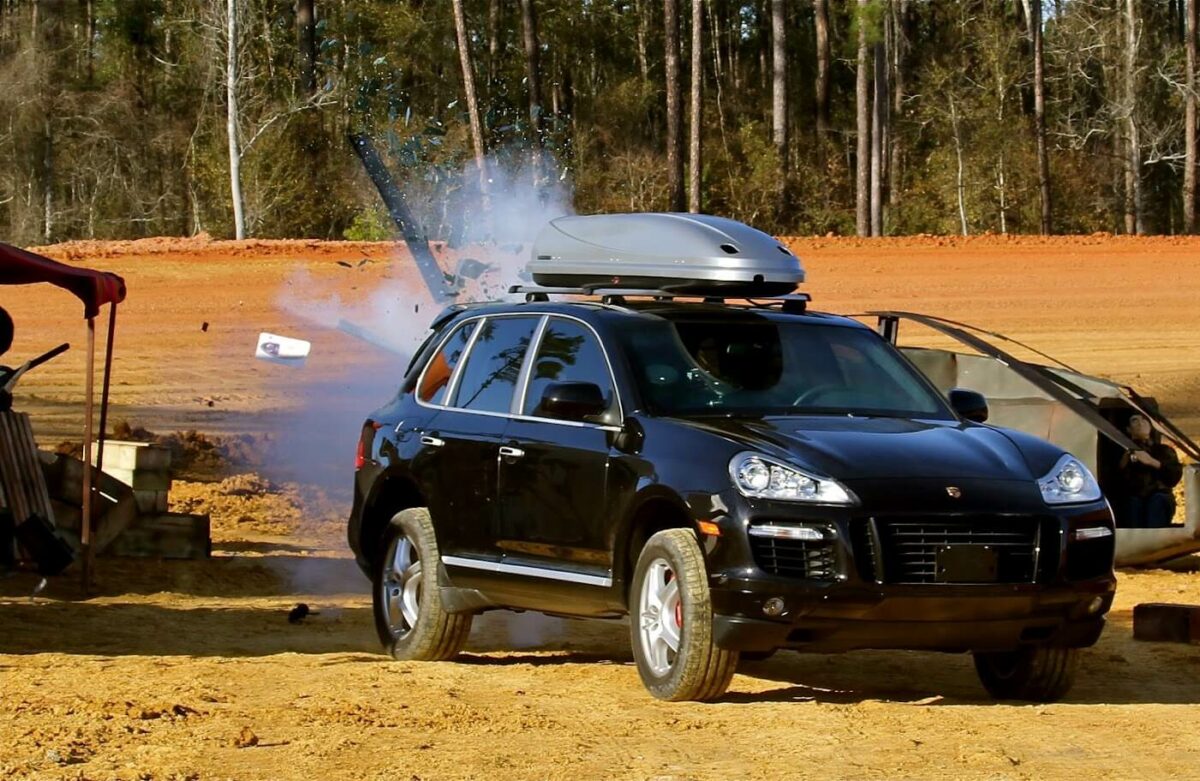
Vehicle blast testing (see image above) evaluates protection against explosive threats using calibrated TNT charges detonated at specified standoff distances. The test measures floor deflection, cabin overpressure, and structural integrity to ensure occupant survivability. Blast testing follows protocols adapted from military standards.
Two primary blast scenarios receive testing:
Under-vehicle blasts simulate roadside IEDs or mines detonated beneath the vehicle. Charges are positioned at the vehicle centerline at specified standoff distances (typically 2 meters). Floor deflection is measured—excessive deflection causes lower limb injuries even if the floor doesn’t penetrate.
Side blasts evaluate protection from explosions beside the vehicle. Charges are placed laterally at 2-5 meter distances. Door integrity, window retention, and cabin pressure are measured.
Blast weight and standoff distance determine threat level. Common test scenarios following STANAG protocols include:
STANAG Level 1: 6kg TNT at 2-meter standoff (lower protection level)
STANAG Level 2a: 15kg TNT at 2-meter standoff beneath vehicle (medium protection level)
STANAG Level 2b: 15kg TNT at 2-meter side standoff (high protection level)
was “conducted by a leading independent third party, at their test facility in Texas, on May 3rd and 4th.” The vehicle was “certified that the vehicle withstood the blasts in accordance with the requirements of the vehicle acceptance test (Blast Certification) by full scale trial according to the VPAM standard – ERV 2010 (VR6/VR7).”
Floor deflection limits prevent injury. Maximum allowable deflection typically ranges from 25-35mm depending on the standard. Greater deflection risks tibial and femoral fractures from the floor striking occupants’ feet and legs.
Cabin overpressure measurement determines whether the blast wave entering the cabin exceeds survivable limits. Peak overpressure must remain below thresholds that cause lung damage and traumatic brain injury. Exact limits are often classified but generally fall below 35 kPa.
Structural integrity assessment examines:
- Door seal retention (doors must remain closed and sealed)
- Window retention (glass may crack but must stay in frame)
- Floor plate attachment (no separation from vehicle structure)
- Suspension component failure (vehicle must remain mobile)
Run-flat tire systems are validated as part of the blast testing process. During testing, the vehicle’s wheels are equipped with certified run-flat devices designed to allow continued mobility even after complete tire deflation. These systems enable the vehicle to travel at operational speeds for up to one hour with fully punctured tires, ensuring the ability to escape from a hostile or ambush situation.
High-speed cameras record the blast event at 10,000+ frames per second, capturing critical data on how the vehicle and its armor systems respond to the explosive force. This footage allows engineers to analyze armor performance, identify potential failure mechanisms, and make necessary design improvements if any vulnerabilities are detected during testing.
Key Takeaway: Blast testing uses calibrated TNT charges (6-25kg) detonated at 2-meter standoff distances, measuring floor deflection (must stay under 25-35mm), cabin overpressure (below 35 kPa), and structural integrity to validate protection against explosive threats following STANAG protocols.
How Is Vehicle Performance Tested After Armoring?
Post-armor performance testing validates that added weight hasn’t compromised vehicle safety or drivability. The Drive reports that “depending on the protection level, about 500 to 1500 pounds may be added to the vehicle.” This weight significantly impacts braking, suspension, and handling.
Braking distance testing measures stopping performance with armor weight. Test protocols follow FMVSS (Federal Motor Vehicle Safety Standards) procedures adapted for heavier vehicles. Braking tests occur from multiple speeds (30 mph, 60 mph, 80 mph) on dry and wet surfaces. Braking distance typically increases 15-25% with 1,500+ pounds of armor added.
Weight distribution affects braking performance differently than total weight alone. Armor concentrated in doors and roof pillars raises the center of gravity, increasing rollover risk. Front-heavy armor distribution extends braking distances more than evenly distributed weight. Armored doors can weigh 200-400 lbs more than stock doors, affecting vehicle balance.
Suspension load testing verifies components can handle armor weight without failure. Tests include:
Static load measurement – Vehicle ride height under full load (armor + occupants + cargo) to ensure adequate ground clearance and suspension travel
Dynamic load testing – Driving over obstacles and rough terrain to test suspension travel and bottoming, validating spring rates and damping remain appropriate
Durability cycling – Repeated loading/unloading to verify spring and shock absorber longevity under extended use
Handling and stability tests evaluate vehicle control with armor weight. Slalom courses, emergency lane changes, and skid pad testing reveal handling characteristics. Armored vehicles typically exhibit:
- Reduced cornering speed before tire grip loss
- Increased body roll in turns due to raised center of gravity
- Longer stabilization time after steering inputs
- Altered weight transfer during acceleration/braking
Door seal and water intrusion testing ensures armored doors maintain weatherproofing. Armored doors stress hinges and compress door seals differently. Water spray tests per SAE standards verify seals remain effective. High-pressure water spray at door seams, wind noise testing at highway speeds, and door alignment verification after repeated opening/closing cycles confirm seal integrity.
HVAC system performance receives validation. Thicker windows and additional sealing reduce cabin ventilation. Testing confirms climate control systems can maintain comfortable temperatures with reduced air exchange.
Electrical system testing verifies power windows, locks, and accessories function with heavier components. Armored doors require upgraded window regulators and more powerful actuators. Load testing ensures these systems operate reliably over the vehicle’s service life.
Noise, vibration, and harshness (NVH) testing measures interior comfort. Armor can reduce road noise (beneficial) but also transmit vibrations differently through the structure. Accelerometers and sound level meters quantify changes from stock configuration.
For providers like Armormax, which specializes in maintaining world-class performance in armored vehicles, these post-armor validation tests ensure the vehicle remains practical for daily use while providing protection. The balance between security and usability depends on thorough performance testing.
Key Takeaway: Post-armor performance testing validates braking distance (typically increases 15-25% with 1,500+ lbs armor), suspension load capacity, handling stability with raised center of gravity, door seal integrity with 200-400 lb heavier doors, and electrical system function to ensure the armored vehicle remains safe and drivable.
What Certifications Must Bulletproof Vehicles Pass?
Bulletproof vehicles require certification from recognized standards bodies or independent testing laboratories to validate protection levels. Armored1 notes that “compliance with these standards thus helps ensure that armed personnel in an armored vehicle will be able to protect occupants from these defined hazards.”
Three primary certification frameworks govern armored vehicles:
NIJ (National Institute of Justice) – U.S. Department of Justice standard NIJ 0108.01 primarily for body armor but adapted for vehicle armor components. NIJ certification requires testing by approved laboratories following documented protocols.
CEN 1063 – European standard EN 1063 specifically for security glazing and transparent armor. CEN certification requires testing at accredited facilities following EN standards.
VPAM (in German language: Vereinigung der Prüfstellen für angriffshemmende Materialien) – a German association of testing facilities for attack-resistant materials. VPAM certification is widely recognized in Europe and internationally.
Third-party testing provides independent verification. describes itself as “a global leader in testing and certification for the aerospace and military industries, offering comprehensive, transparent armor and glass testing services.” Independent labs eliminate manufacturer bias in test results.
Manufacturer self-testing lacks independent oversight. While manufacturers may conduct internal testing during development, certification requires external validation. Intertek notes they provide “the convenience of receiving testing from a single, trusted vendor” with “decades of experience in the glass industry.”
Certificate validity typically lasts 5 years from the test date, assuming the armor configuration remains unchanged. Design modifications, material substitutions, or manufacturing process changes require re-testing. This prevents “certification drift” where vehicles gradually deviate from tested specifications.
Re-testing requirements apply when:
- Armor materials change (different steel alloy, glass composition, etc.)
- Manufacturing processes are modified
- Vehicle model changes (even same make/model year)
- Protection level is upgraded
- Certification expires (typically 5 years)
Verification of vehicle certification requires reviewing official test reports. Legitimate certifications include:
- Testing laboratory letterhead and accreditation numbers
- Specific test dates and ammunition lot numbers
- Impact velocities for each shot
- Pass/fail results with measurements
- Photographs showing shot placement and results
Big Toy Automotive reports that “Armormax India is seeing a sharp increase in demand for bulletproof cars and armored vehicles in 2025 (with more growth in 2026),” with “bulletproof car price in India: ₹12–25 lakh” for upgrades. This growing market increases the importance of verified certification to distinguish legitimate armor from inadequate protection.
Red flags indicating questionable certification:
- Vague certificates without specific test data
- Testing by unaccredited facilities
- Missing ammunition specifications or velocities
- No photographic documentation
- Certificates older than 5 years
- Manufacturer self-certification without third-party validation
For buyers evaluating armored vehicles, requesting complete test reports from recognized laboratories provides the only reliable verification. as “the only manufacturer whose certified armored vehicles passed both VPAM VR7 and United States Army Aberdeen Proving Ground requirements” demonstrates the value of multiple independent certifications.
Key Takeaway: Bulletproof vehicles require certification from recognized bodies (NIJ, CEN 1063, VPAM) through independent third-party testing laboratories like Intertek or H.P. White, with certificates valid for 5 years and requiring complete test reports showing specific ammunition, velocities, and photographic documentation for verification.
Recommended Armored Vehicle Testing and Manufacturing
When evaluating armored vehicle providers, look for manufacturers who prioritize independent third-party testing and transparent certification processes. Armormax specializes in manufacturing technologically advanced armored vehicles with documented testing protocols.
Key factors that distinguish reputable armored vehicle manufacturers:
- Independent certification: Testing conducted by accredited third-party laboratories rather than internal facilities
- Transparent documentation: Complete test reports available showing ammunition types, velocities, and results
- Multiple standard compliance: Vehicles tested to both U.S. (NIJ) and international (CEN, VPAM) standards
- Performance validation: Post-armor testing confirms braking, handling, and suspension meet safety requirements
- Manufacturing expertise: Established processes ensuring consistency between tested prototypes and production vehicles
Armormax focuses on maintaining world-class performance in their armored vehicles while meeting rigorous protection standards. This balance between security and usability requires comprehensive testing throughout the manufacturing process—from material qualification through final vehicle certification.
For buyers researching armored vehicles, requesting detailed test reports and visiting manufacturing facilities provides insight into quality control processes. The most reliable manufacturers welcome transparency and provide documentation supporting their protection level claims.

FAQ: Bulletproof Vehicle Testing Questions
How much does bulletproof vehicle testing cost?
Direct Answer: Ballistic testing and certification will vary depending on protection level and testing comprehensiveness.
Full vehicle ballistic testing and certification varies significantly based on the number of components tested, ammunition required, and whether blast testing is included. Higher protection levels require more extensive testing with expensive ammunition (armor-piercing rounds), increasing costs. Re-testing after failures adds 40-60% of original testing costs. These costs are typically included in the vehicle’s final price rather than charged separately to buyers.
What is the difference between NIJ and CEN armor standards?
Direct Answer: NIJ is the U.S. standard focusing on body armor adapted for vehicles, while CEN 1063 is the European standard specifically designed for security glazing and vehicle armor.
NIJ standards define protection levels from IIA through IV based on U.S. ammunition types with 6 shots per panel at 2-inch spacing. CEN 1063 uses BR (Bullet Resistant) classifications from BR1 through BR7, with specific velocity requirements in metric units and 3 shots at 120mm spacing. that “the minimum required steel thickness for this level of protection is 7.5mm” for lower levels, increasing to “18mm” for highest protection. The standards use different test methodologies and acceptance criteria, though both validate similar threat levels.
How long does bulletproof vehicle certification take?
Direct Answer: Complete certification from vehicle arrival to final documentation typically takes 6-8 weeks for standard protection levels.
The Drive reports that “it takes six to eight weeks to armor typical vehicles like a Mercedes-Benz, Range Rover, Escalade, Tahoe, or Suburban.” This timeline includes material testing (2-3 weeks), armor installation (1-2 weeks), ballistic testing (3-5 days), and final documentation (1 week). Higher protection levels requiring blast testing can extend the timeline to 10-12 weeks. they have “the fastest turnaround times in its industry” with “the full armoring process of a vehicle can typically be completed in less than a month.”
Can you verify if a vehicle passed testing?
Direct Answer: Yes, by requesting official test reports from the testing laboratory showing specific ammunition, velocities, shot placement photographs, and pass/fail results.
Legitimate certifications include detailed documentation from accredited laboratories like H.P. White Laboratory, Intertek, or Thales Group facilities. Test reports should show testing laboratory letterhead with accreditation numbers, specific test dates, ammunition lot numbers, chronograph readings for each shot, and photographic documentation of shot placement and results. Buyers should verify the testing laboratory’s accreditation status independently. Vague certificates without specific technical data or testing by unaccredited facilities indicate questionable certification.
What happens if armor fails testing?
Direct Answer: Failed armor requires remediation (material replacement, redesign, or re-welding) taking 2-6 weeks before re-testing at additional cost.
Common failure modes include glass delamination, incomplete weld penetration, and door seal leaks. Glass replacement typically requires 2-3 weeks for new material fabrication and installation. Structural redesigns addressing weld failures may require 4-6 weeks. Re-testing costs approximately 40-60% of original testing fees since fewer shots are needed but full documentation is still required. that “of thousands of vehicles armored so far, not a single incident of armor penetration has been reported” by established manufacturers, suggesting quality control reduces failure rates.
Do bulletproof vehicles need retesting over time?
Direct Answer: Certifications typically remain valid for 5 years if the armor configuration remains unchanged, but modifications require re-testing.
Certificate validity assumes no material changes, design modifications, or manufacturing process alterations. Routine maintenance and component replacement with identical specifications don’t require re-testing. However, upgrading protection levels, changing armor materials, or modifying vehicle structure necessitates new certification. Some fleet operators conduct periodic verification testing on in-service vehicles to ensure armor hasn’t degraded, though this isn’t universally required.
Are manufacturer tests as reliable as third-party testing?
Direct Answer: No, manufacturer self-testing lacks independent oversight and audit trails that third-party accredited laboratories provide.
Third-party laboratories maintain ISO/IEC 17025 accreditation, requiring documented quality systems, calibrated equipment, and external audits. Manufacturer testing may use proper methodology but lacks the independence that prevents bias in results. Serious buyers should require certification from recognized independent laboratories rather than accepting manufacturer self-certification.
For personalized guidance on this topic, Armored Cars, Bulletproof Car, Armored Vehicles by Armormax (https://www.armormax.com) can help you find the right approach for your situation.
Conclusion
Bulletproof vehicle testing follows rigorous protocols validating ballistic resistance, blast protection, and post-armor performance through independent third-party certification. The complete process—from material qualification through final documentation—requires planing which can take several weeks depending on the company that is doing the certification.
Understanding testing standards (NIJ, CEN 1063, VPAM) and verification procedures allows buyers to distinguish legitimate protection from inadequate armor. emphasizes that testing implements “zero tolerance for errors” because occupant safety depends on documented, verified protection.
For those evaluating armored vehicles, requesting complete test reports from accredited laboratories provides the only reliable verification. Manufacturers like Armormax that prioritize transparent testing and independent certification demonstrate commitment to genuine protection rather than marketing claims.